What we’re trying to prove:
A particle sliding down a cycloid under gravity, considering friction to be non-existent will take the same time to reach the lowest point regardless of its starting point on the curve.
Cycloid?
A cycloid is the curve traced by a point on the rim of a rolling circle.
Consider the radius of this circle to be r.
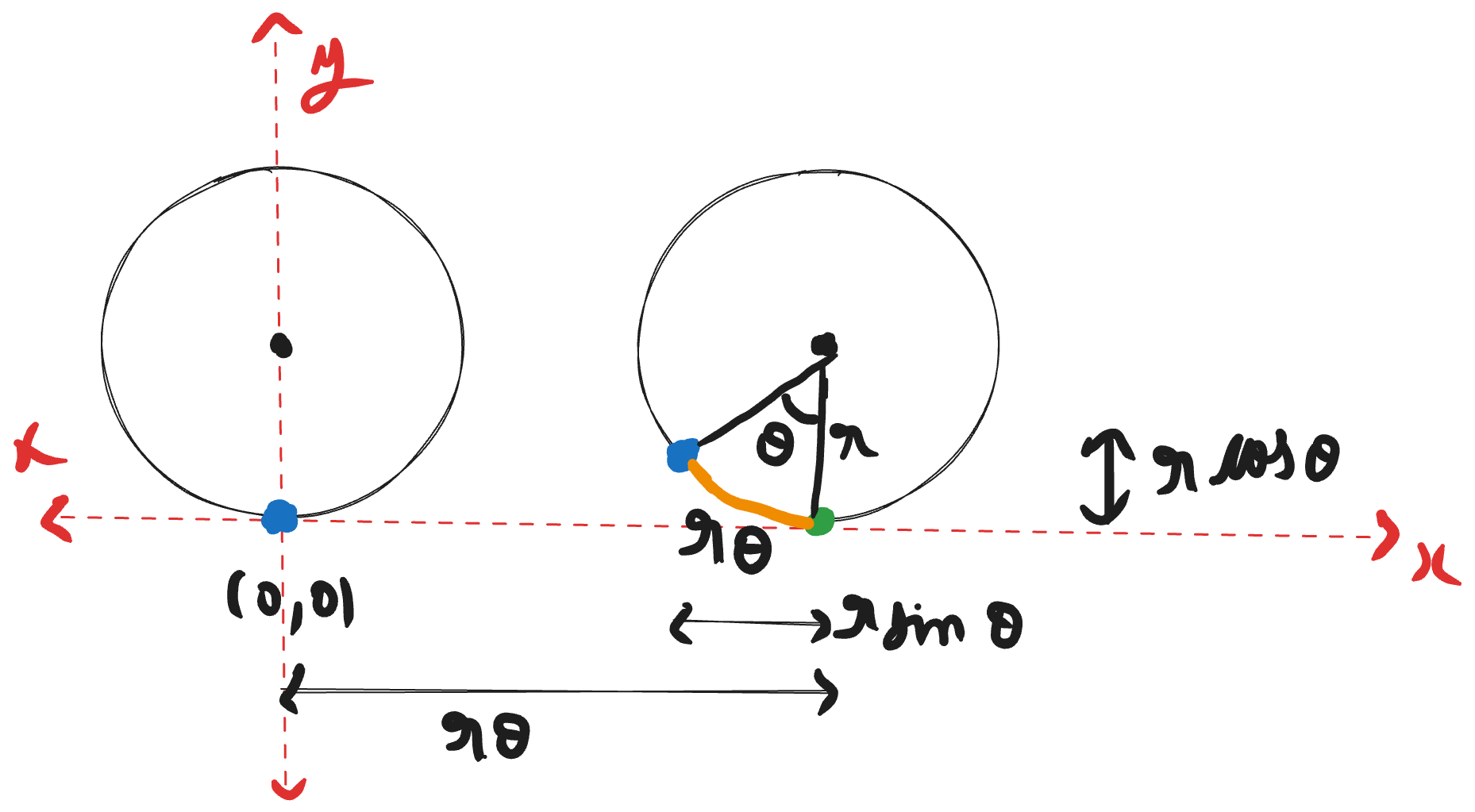
From the diagram, we can clearly see that:
From which we get:
For any curve:
We know that:
From energy conservation,
Substituting and
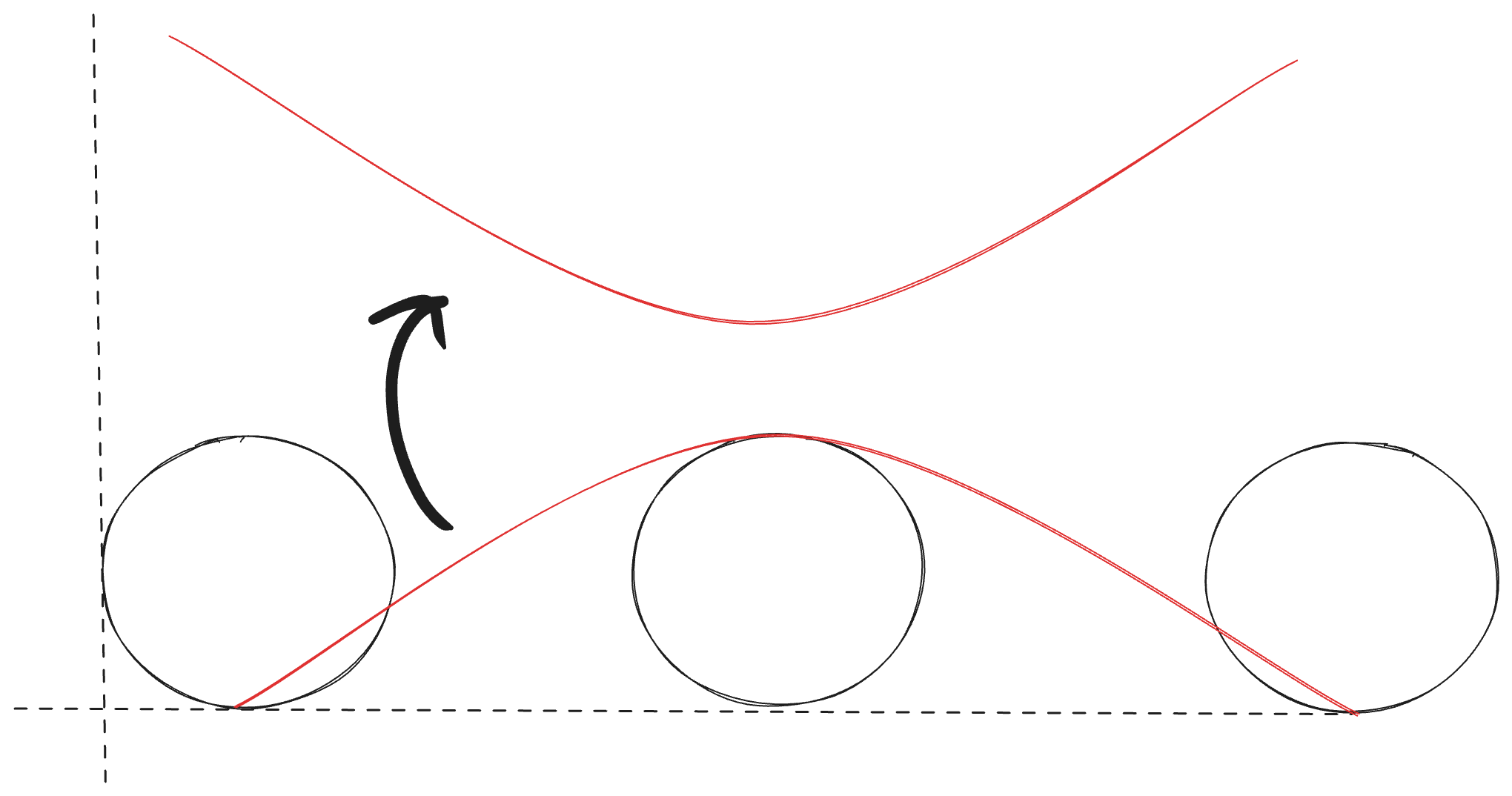
It is very important to note here that in this problem, we consider the cycloid to be inverted. Therefore, we interpret y as the depth BELOW the starting point and not the height above the ground.
In other words, we treat y = 0 as the top of the curve and y = 2r as the bottom. Therefore, for the bottom. It is not 0.
So when we integrate to get the time of descent we take the upper limit to be and the lower limit to be which is arbitrary.
Let and Replacing with and substituting in the equation, we get:
Therefore, we can see that the time of descent is not dependent on the initial angle .
This property, that all particles reach the bottom simultaneously regardless of their starting point is known as isochronism and it’s what makes the cycloid the solution to the Tautochrone problem.